Category: Uncategorized

  • The Forbearance of God in Execution of Judgement

    The Forbearance of God in Execution of Judgement

    One most important but extremely missing ingredient of Love is forbearance or long-suffering. It has quickly become an unpopular word, almost Old English, barely heard or used in everyday English. It’s not even associated with Love anymore and yet, it’s an underlying theme in the entire Scriptures. Without forbearance, love has an expiry date. Agape Love is understood in this light because the Love that suffers long does not make sense. That notwithstanding, it makes everything else make sense, makes patience a reality, bitterness an abomination and love worthwhile. Let’s delve in!

    Love Suffers Long

    I know forbearance is old school to this generation. This generation will definitely call this kind of Love stupid, reckless or even immature. Yet, this is what covenanted love looks like. “If we are faithless, He remains faithful; for He cannot deny Himself”. Hosea experienced this love when God used him as a shadow of His love life. Hosea had to love and be faithful to his prostituting wife. His love was not conditional; based on her performance and actions. His love was unconditional; based on himself.

    Hosea is not the only one to have embraced this God kind of Love. It was the same chesed Hebrew word used in Ruth’s love for Naomi, David’s love for Jonathan, . It is the same “I’m-not-going-anywhere kind of Love. It is steadfast loyalty, tender mercies, lovingkindnesses. This part can be well understood until we add another ingredient; the wrath of God. See, our love for God ought to include our fear of Him. You separate the two at your own peril. If you love God but don’t fear Him, you’ll begin to live the kind of life that takes evil advantage of His kind of Love.

    Judgement as an Act of Love

    When it comes to judgement in this context, I’d like to separate it into two; chastening as discipline & executing judgement as justice. It’s not everyone that God chastens. The chastening is part of God’s grooming activity as Bridegroom to His Bride. Not that God is showing favoritism but He can only discipline those who have surrended to Him. In Psalm 32:4, we see the Hand of God upon David when he sinned. This Hand was not responsible for favour but judgement. However, the judgement is not the ultimate or final verdict. Whenever you fall into sin, this Hand falls heavy upon you until you return to your true place.

    God’s chastening is important, especially in this age where we are not fully perfect. Although you are not perfect, you ought to strive towards mastery because you have been perfected and given all things that pertains to life and godliness. It is God’s way of saving you from His wrath when He chastens you. Immediately you begin to deviate, you lose your peace. If you sin, you feel conviction from His Spirit. If your prayer life and relationship with God is diminishing, you feel unsatisfied in your spirit. Sometimes, God’s chastening may mean failing where you’re supposed to succeed because if you had succeeded without God, you would have stayed longer in your deviation.

    Have you realized God is not wicked? He disciplined you out of love but you thought He was being too hard on you. He’s insisting on you more than you see Him to do others doing worse than you did. Don’t compare yourself to them. They chose to live comfortably in sin. You chose to surrender to Christ. Therefore, He chastening you is legit and must be taken seriously because God takes you seriously. His Love suffers long for you until you reach the full statute of Christ. Do you realize God never reduced or suspended His standard of righteousness and holiness and Justice? Meanwhile, this is a standard all humanity fell short of. God would have been still right to condemn all of us. He didn’t because His Mercy literally endures forever.

    Forbearance in Light of Swift Judgements & Making Hell

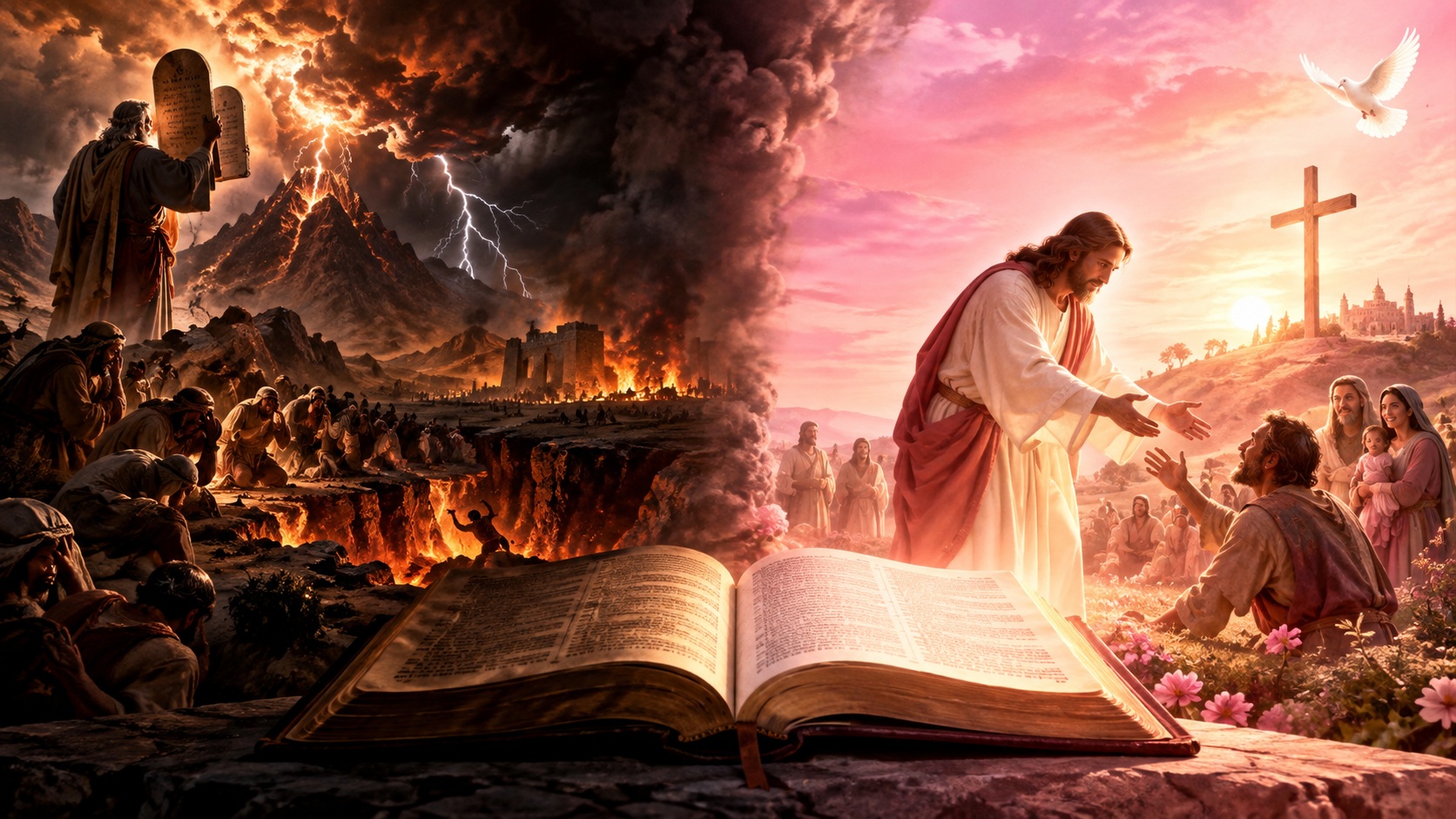
    God’s anger is His ability to carry out judgements against evil, and God’s wrath is His ability to execute His anger. Do you know what? He does not suspend His love in this equation. His anger only exists because of His Love. Just as a father disciplines His children, so does the Lord chasten those He loves. Even allowing someone to go to hell is an act of God’s Love. The power of choice only exists because of Love, and although it breaks God’s heart that you choose something else above Him, He ultimately acknowledges your position to spend eternity without Him. That is Love. He made an intervention by paying such a hefty price to save you, but He won’t force you to spend time with Him if it’s not your will.

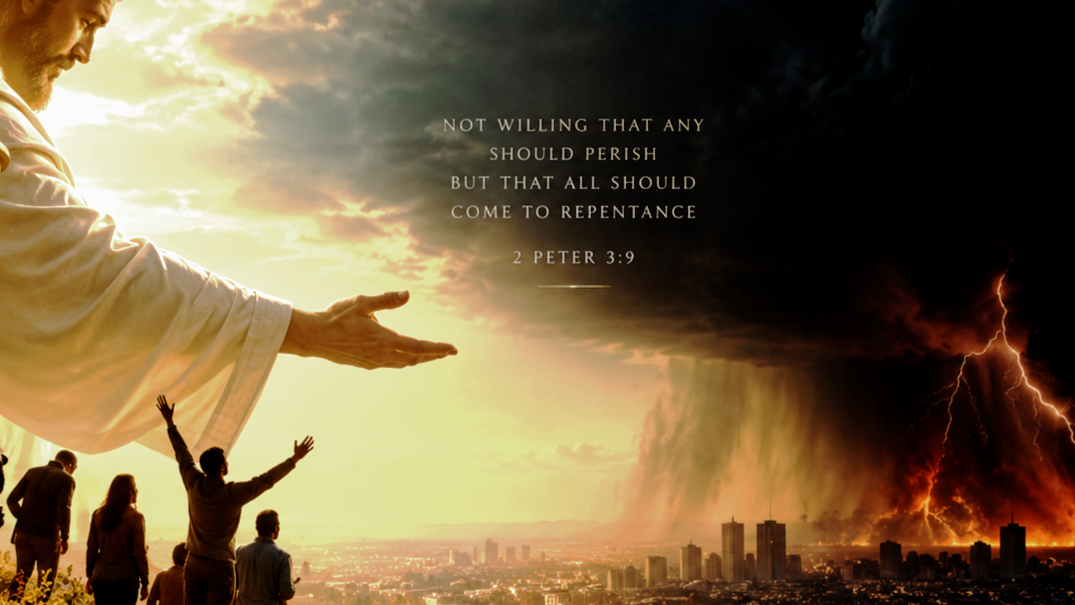
    He is not willing that anyone should perish but those without everlasting life will perish. It’s those with everlasting life who should not perish. We think Omnipotence is using power to bully and override will. However, God shows His true Power by self-restraint. On the Cross, Christ restrained Himself and laid down His life for me although He had the power to scatter the whole thing. God also demonstrates restraint in not punishing outrightly when injustice is committed. Therefore, what you’re seeing in this New Testament is not God cancelling judgement and Justice forever but restraining judgement until it’s time to sit on the Throne of Judgement.

    Right now, He sits on the Throne of Grace so it’s easy to think you can fool and get away with it in the New Testament, unlike in the Old. That’s a lie from the pit of hell. God by no means let’s the guilty go unpunished. Remember, there are more stories in the Old Testament than the New. So it’s not surprising to see more swifter judgements of God in the Old than in the New. What is written in the Old was written for our learning. There are still certain states a man can put himself in to warrant God’s swift judgement, just like in the Old Testament. In fact, the New Testament has several warnings of God’s judgements, both the swift ones and the ones that tarries but happens suddenly. We’ll discuss all that soon. The question one may ask is, why is God putting up with all this inconsistencies of men.

    Saved by Grace, Made by Grace

    That is why God created humans in the first place. He foresaw all of this and decided to go on with His marvelous plan. In Ephesians 2:4-7, Paul is revealing something eternal and monumental. Before God made man, He already foresaw our fall; our rebellion, sin, and separation. And yet, rather than abandoning the plan, He chose to proceed, because in man’s fall, He saw the perfect opportunity to reveal a dimension of His nature that even angels, principalities, and powers had never known before: grace.

    You see, angels see His holiness, His justice, His power, His wisdom, but never His saving grace. There’s no redemption plan for fallen angels. But with us fallen, broken, rebellious humanity, God poured out His immeasurable love, not because we deserved it, but precisely because we didn’t.  Here’s the mind-blowing part: In the ages to come, meaning eternally, forever, and ever, God will point at you, yes you, as a living, breathing, glorified, eternal example of what His grace can do. You’ll be the display case, the exhibit, the masterpiece that says, “Look what the mercy and kindness of God can produce.”

    It transcends time and creation. New beings, creations, or realms of existence will behold you and marvel, not at you, but at the riches of His grace that you represent. You are proof that God’s love is so powerful, it can transform the dead into life, the lost into seated heirs, the doomed into glorified co-kings with Christ. I have uncovered a glimpse of my eternal significance in God’s eternal story, and all was made possible because God’s Love suffers long. Throughout this entire imperfect journey and sanctification process, the Holy One tolerated my human weakness and frailty, knowing that the good work He has begun in me can be brought to a good and expected end.

    To be continued…

  • Is the God of the Old Testament Different from the God of the New Testament?

    Is the God of the Old Testament Different from the God of the New Testament?

    In the Old Testament, we saw a fierce and gruesome dealing from God towards what men felt were petty mishaps. We first saw a fervent display of God’s righteous standard with the death of Aaron’s sons. Fire came down from Heaven to destroy them for putting strange fire on God’s altar. Also, Aaron was forewarned not to complain or mourn their deaths personally. Even good intentions did not do. Speaking of good intentions, Uzzah thought he was being of help to the Ark that was slipping off the cart. He died on the spot, and even David was confused and furious.

    It’s not just the Israelites: Men of Beth-shemesh in Philistia died mercilessly later for simply looking the Ark of the Covenant. Korah challenged Moses and it suddenly became a matter of life and death. God caused the earth to open and swallow up not only Korah, but his supporters and their households. 14,700 people died. Imagine dying because your uncle thought he was right. That reminds you of Achan, right? His wife and children were burnt to purge God’s camp of his abomination.

    God’s Judgement in the Old Testament

    Korah was not the only one to challenge authority; Miriam had her fair share of leprosy for boasting about being God’s spokesperson too. The sons of Aaron aren’t the ones to taste God’s consuming fire. In Taberah, when they complained against God for saving them from Egypt in Numbers 11, it wasn’t taken lightly. Fire also came down from Heaven to destroy Sodom and Gomorrah, a city never rebuilt until now. In Numbers 21, God sent fiery serpents to the camp of Israel as judgement for their stiff-necked attitude. Not forgetting the plague at Peor in Numbers 25.

    Stubborn leaders like Eli and Saul and their sons died gruesomely after God rejected their house and rule. What about Er and Onan, sons of Judah whom God struck. Er died suddenly for being wicked, and Onan died because he spilled his semen with the intention of not bearing children for his brother’s lineage. Lot’s wife turned into a pillar of salt. The entire earth populace was wiped clean with a flood, leaving only 8 humans.

    More Examples

    A man simply gathered sticks on the Sabbath in Numbers 15:32. Another man in Leviticus 24:10 cursed the Name of God in a fight. Moses sought the Will of God in both occasions and it all ended the same; they were stoned outside the camp. David took a census against God’s Will and innocent people going about their day were killed, leaving a whooping 70,000 dead at the end of the day. Gehazi made an error and his entire lineage had to pay for it. Job was called blameless and upright and God-fearing in the very verse of the book. Yet, he lost all he had, including his 10 children, in one moment. What about God instructing the Israelites to kill an entire ethnicity, including innocent women and children?

    Time will not permit me to talk about God using more evil nations to punish His own people, of King Uzziah, of King Ahaziah’s messengers, of Judges 19-21, of Jonah and Nineveh, of Habakkuk’s interrogation with God, of Job’s intellectual discourse as well, and the prophetic intercessions of Jeremiah, Ezekiel, Daniel, Samuel and the prophets to slow down the swinging pendulum of justice against sin and evil in their days. Leaving this at face value, you may have a problem with God’s judgement, or at least, a question. Especially when you compare it to the New Testament outlook.

    1st Deviation: God of Love

    There are two deviations I see as we humanly try to reconcile God’s Love and God’s Wrath; one school of thought will completely denounce all these numerous examples of God’s judgement as misconceptions and paint a God full of Love. Since Jesus is the fulness of the revelation of God and did not kill during His 33-year tenure on earth, therefore God does not kill. Meanwhile, my non-exhaustive list of God’s judgement can be grouped under 4 main ways;

    A. God directly executed the punishment, like in the case of Aaron’s sons.

    B. God explicitly prescribed the punishment, like the ones Moses inquired and also instructed in the Law.

    C. God commanded His people to execute judgment, like in the case of Achan and the surrounding nations of Canaan.

    D. God allowed another agent to execute judgment, like he using Nebuchadnezzar and Assyria to punish Israel.

    However, no matter how merciful God is, God never shows unjust mercy. Also, Jesus’ first coming was about Grace and Truth. His 2nd coming is about Righteousness and Justice. God’s fiercest relevation of God is seen, not in the Old Testament, but the New. The 7 seals, 7 bowls and 7 trumpets, executed as the Wrath of the Lamb (this same Jesus), did not come from hell but Heaven.

    2nd Deviation: God of Wrath

    The second deviation is to paint God as an angry, wrathful, non-forgiving Being who just wants to vanquish people. This is completely wrong. Some even make a mistake of dichotomizing the God in the Old Testament from the New. We make God the Father look like the Wrathful One, and make Jesus look like the Lovely One. We even try to justify it by comparing the intolerance of God the Father to the loving nature of Jesus in the New. After all, in the Old in comparison with the New Testament, the closest thing to sudden divine judgements is Ananias and Sapphira, and perhaps Herod in Acts 12. Meanwhile, when the New Testament talks about Love, it is mostly attributed to person of God the Father (1 John 3:1, John 3:16, 2 Corinthians 13:14). God is One.

    That is the importance of this series. God remains unchanging in His Nature. We shall explore Grace in the Old Testament, and see Judgement in the New, lest we abuse the Grace of God and think God will still treat us better than the Israelites of Old because we live in the New Covenant. Will He?

    To be continued…

  • The Judgement of God upon Jesus: Zechariah 3 Explained

    The Judgement of God upon Jesus: Zechariah 3 Explained

    The second death which faces mankind brings fear, dread and torment to him all of his lifetime. This was the death Jesus took for us. When he hung there on the cross, it wasn’t the anguish of the physical torment, although he felt everything that we could possibly feel; and it wasn’t the separation from people whom he held dear, although he felt it just as keenly as anyone; but Jesus suffered pains that even the ungodly, those totally separated from God, had never felt, for the ungodly have never felt the pangs that come when the last little flicker of hope is extinguished and they hear the words, “Depart into eternal damnation.” While living on this earth, they have never felt the weight, the hopelessness and the horror of feeling the cold side of God as he turned his back on them.

    Jesus suffered the torment of a damned soul. From his heart he cried out, “Oh, God, why have you forsaken me?” and the cold pangs of eternal damnation, those icy fingers gripped his life, and Jesus suffered the judgment of God. He was totally separated from God at that moment.

    (Oh, God. Oh, God. Oh, God. Oh, God. I want to bring this truth to people. Build a picture before us right now. Let us see what you have done. Let us see your love for us that was so great that your only begotten Son became our substitute.)

    The Spirit told me to give the message that your sin has already been judged; the separating barriers between God and man are down; you are free, liberated by his power; and you can be restored to a place of total innocence, to man’s original position of closeness and fellowship with God.

    The importance of this message is seen by the reminders of the sacrifice in every message that has been brought by the angel. I remember so distinctly the very first time Gabriel came, he unfolded a beautiful truth from the third chapter of Zechariah. He said, “You have been aware of the sacrifice of Christ as seen from the earth which is from man’s viewpoint; now would you like to see what happened from God’s viewpoint?”

    Instantly, he allowed me to see Jesus, the spotless Lamb of God, totally sinless, as a moving, living panorama, coming from the Father to earth. Then Gabriel said, “Now look at him as he returns to heaven.” Then I saw Jesus bowed down, with his priestly garments torn and splattered with mud, filthy with the rot and the stench of the world. He came with his shoulders bowed, into the presence of God. My heart broke when I saw that. I saw Jesus in a different light than I had ever seen him before. I saw him coming into heaven from the darkness of the pit of hell, bearing the sins of the whole world.

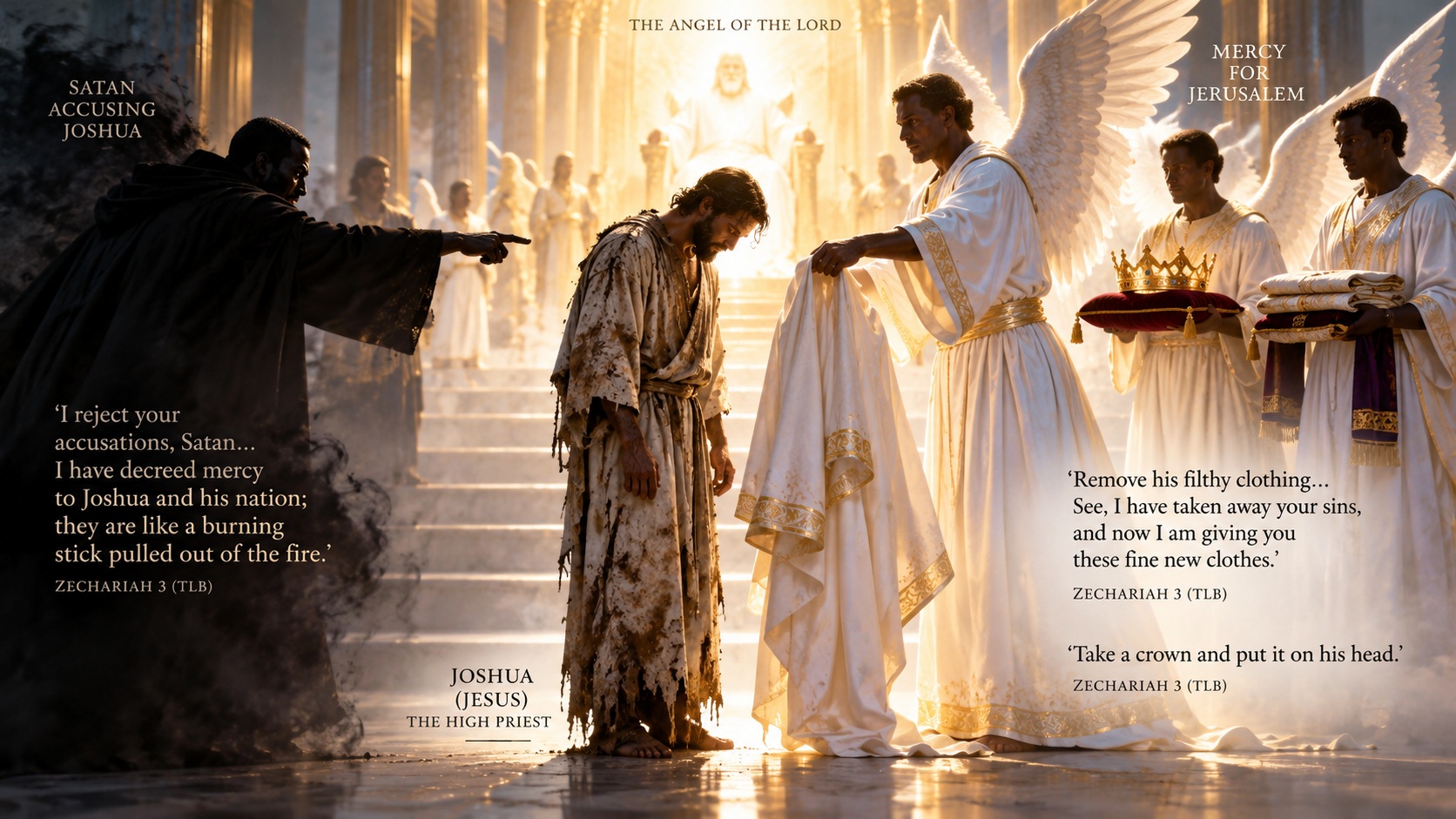
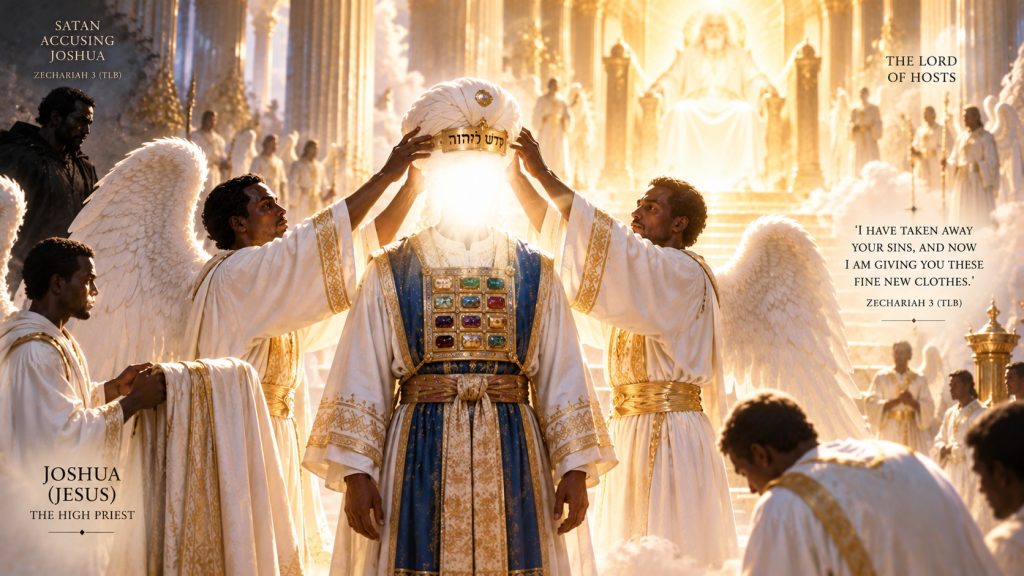
    Then as Jesus stood there, bowed, with God’s back turned towards him, Gabriel, the angel of the Lord, spoke in a loud voice and said, “Take those filthy garments from him, remove them to a place where they will never be found, and put on him now the new, kingly robes, the royal priestly robes.” Then the angels who stood before him placed the robes over him and Gabriel said, “Take a crown and put it on his head.” On that crown was the message that ascended before God: “Holiness to the Lord.” Count all of those people who follow me as holy. Accept them because of what I have done. There it was, written right across the crown. That’s when Jesus became our King and our High Priest.

    I had read the third chapter of Zechariah many times, but not until Gabriel reminded me did it occur to me that in the Greek language the name of Joshua is really the name Jesus. I had never before seen the truth of how Jesus returned to heaven. All of Zechariah 3 is quoted here so that you will see the prophecy fulfilled exactly as God allowed me to see it in this beautiful:

    Then the angel showed me (in my vision) Joshua (Jesus) the High Priest standing before the Angel of the Lord; and Satan was there too, at the Angel’s right hand, accusing Joshua of many things. And the Lord said to Satan, ‘I reject your accusations, Satan; yes, I, the Lord, for I have decided to be merciful to Jerusalem – I rebuke you. I have decreed mercy to Joshua and his nation; they are like a burning stick pulled out of the fire.’

    Joshua’s clothing was filthy as he stood as he stood before the Angel of the Lord. Then the Angel said to the others standing there, ‘Remove his filthy clothing.’ And turning to Joshua he said, ‘See, I have taken away your sins, and now I am giving you these fine new clothes.’

    Then I (Zechariah) said, “Please, could he also have a clean turban on his head?” So they gave him one. Then the Angel of the Lord spoke very solemnly to Joshua and said, ‘The Lord of Hosts declares: If you will follow the paths I set for you and do all I tell you to, then I will put you in charge of my Temple, to keep it holy; and I will let you walk in and out of my presence with these angels.

    Listen to me, O Joshua the High Priest, and all you other priests, you are illustrations of the good things to come. Don’t you see” – Joshua represents my servant The Branch whom I will send. He will be the Foundation Stone of the Temple that Joshua is standing beside, and I will engrave this inscription on it seven times: I will remove the sins of this land in a single day.

    And after that, the Lord of Hosts declares, you will live in peace and prosperity and each of you will own a home of your own where you can invite your neighbors. (Zechariah 3, TLB).

    In verses 10 and 11 (of Isaiah 53) are the words that came right from the heart of God and I pray that they will grip you as they did me. “Yet it pleased the Lord to bruise him; he hath put him to grief: when thou shall make his soul an offering for sin …” God took that undying soul and allowed him to swallow, not just a little taste of death, but a taste for every man. His eternal soul was given as an offering for sin.

    As Jesus was put to grief, as he was bruised, as his soul was made an offering for sin, the Bible says now look upon him, look at him, he is giving birth to a new race. He was in travail; his soul travailed. Verse 11 says: “He shall see the travail of his soul, and shall be satisfied.” Verse 10 says, “He shall see his seed, he shall prolong his days, and the pleasure of the Lord shall prosper in his hand.” In making his soul an offering for sin, Jesus made eternal redemption possible for everyone, for the whole world.

    From the agonies of a damned soul was born the seed springing forth. “He shall see his seed.” He saw the church spring up, and he’s looking today at his seed, his offspring his redeemed, his ransomed, his liberated, who have sprouted up from his death.

    When he looks down at you, he says, “I remember the travail upon my soul, and what I see satisfies me, and I like it. You are a member of the family, you are redeemed, and you are a child of God. You are a member of a new race. Not a Jewish race, not a Gentile race, but a member of that new race, a member of the heavenly kingdom, a heavenly race, a royal priesthood.”

    At his death, Jesus was actually being struck by God’s hand with the judgment for the sin of the entire world. At this point, Jesus entered into a total separation from God, and God turned his back upon him because of sin.

    This great messenger that God sent brought this truth home to me so forcefully that as I saw it, I lay in bed and wept. I couldn’t help it – the bed shook because of my seeing the price that Jesus paid and what his sacrifice and our remembering it really represent.

    There is a day coming for many, many people who refuse to identify with Jesus, not realizing that he has already tasted death for them; that he has already become their substitute in judgment. There is a day coming when men will hear those words again, “Depart from me, ye cursed, into everlasting fire …” (Matthew 25:41). They will feel the agony that Jesus experienced, but they don’t have to. God and the hosts of heaven are working full time today to spare men and women from the awfulness of that day.

    Audibly, or just from your heart, say, “Jesus, thank you for tasting death for me. Thank you for destroying all evidence of sin that has been held against me, for removing the records.” It’s just that plain simple.

    This is an excerpt from Charles & Frances Hunter’s famous book, Angels on Assignment. I will recommend that you read the book if never have. This is available for free via the internet. If you still struggle to find a free copy, kindly comment your email and I will send it to you directly. God richly bless you
  • Understanding the Judgement of God II

    Understanding the Judgement of God II

    THE KING AND THE THRONE

    Psalm 72:1: Jesus is the King as Son of God & the King as Son of Man. Judgment is a divine law, ordinance (Acts 17:31). The judgments of the LORD are true and righteous altogether (Ps 19:9). He loves righteousness and judgment; the earth is full of the goodness of the LORD (Ps 33:5). His righteousness is like the great mountains, and His judgments are a great deep (Ps 36:6). He shall bring forth your righteousness as the light and your judgment as the noonday (Ps 37:6).

    Righteousness and judgment are the foundation of the Throne. The sceptre of righteousness is for the King (Ps 45:6-7). Psalm 72:1 means coronate the Son as King. The throne therefore cannot be understood apart from righteousness and judgment. The King reigns, and because He reigns, He judges. His judgment is not an interruption of His kingship. It is an expression of His kingship. This is why the coronation of the Son is also a revelation of the administration of the Throne.

    Acts 2:36 says, “Therefore let all the house of Israel know assuredly that God has made this Jesus, whom you crucified, both Lord and Christ.” Read Isaiah 11:3-5. Once the Throne is given then (Psalm 72:2) (read Ephesians 1:22, 1 Corinthians 15:27-28), He shall rule and reign. He is co-Eternal and co-reigns with the Father. He sacrificed this place for humanity and deservedly received it back for bringing humanity into the co-heir status (Romans 8:17).

    The giving of the throne therefore leads into rule and reign. The Son receives the kingdom, and the kingdom is administered through righteousness and judgment. When we come to the later Psalms, we are not suddenly introduced to a different God. The God who reigns is the God who judges. The righteousness that establishes the throne is the righteousness by which judgment is executed.

    THE COVENANT AND THE COURTS OF HEAVEN

    Psalm 74: Have respect to the Covenant → remember, O LORD. Calling on God to remember demands that one understands the justice of God and the place we have in the courts of Heaven to make certain demands. The language of remembrance is covenantal language. When the Psalmist says, “remember,” he is not suggesting that God has forgotten. He is appealing to what God has already established. He is calling God to act according to His covenant.

    Wherever God delivers His people, it is in remembrance of His Covenant (Lev 26:42). This is how the remembrance of God works. The parameters involved are covenant, tied to mercy → covenanted love; justice; vindication; righteousness. Mercy, truth, righteousness, justice (Ps 36:5-6, Ps 89:14). The covenant is therefore not separated from justice. The covenant is tied to mercy, but that mercy is covenanted love. It is also connected to justice, vindication, and righteousness. This is why calling on God to remember the covenant demands that one understands the justice of God and the place we have in the courts of Heaven to make certain demands.

    Psalm 74:8 says there are meeting places of God, and Psalm 74:20 says there are desolate places of the earth. Both places have altars, which are the embassies of spirits to interact within the realm without disrupting or disobeying the divine order (Ps 115:16).

    GOD THE JUDGE

    In Psalm 75:

    The wondrous works of God become the evidence of His identity. His works reveal His Name. The God who judges is not an unknown Judge. He has revealed Himself through His works. His Name is Near because His hand has acted directly in the affairs of His people.

    Psalm 75:1-7 gives us the revelation of God the Judge. He deserves thanksgiving. He deserves proclamation of praise of works. He has a set time for judgment. He judges in righteousness. He tests all apart from foundation already tested. He warns the wicked, which is Mercy. He judges by Himself. He does not allow evil to go unpunished. He deserves praise after releasing judgment.

    Psalm 75:7: God the Judge = Elohim Shaphat. Ps. 50:6 says, “But the heavens declare His righteousness, for God Himself is Judge.” Ps. 58:11 says, “Surely there is a reward for the righteous; Surely there is a God who judges in the earth.” The Judge is therefore not merely one who determines guilt. “He puts down one, and exalts another.” 1 Samuel 2:7, “He brings low and lifts up.” Daniel 2:21, “He changes the times and the seasons; He removes kings and raises up kings.”

    THE SET TIME OF JUDGMENT

    In Psalm 75, God speaks from v2 to v5. The judgment of God has a set time. God always judges uprightly, with perfect righteousness. God judges all, the earth. This is important because judgment is not an emotional reaction from God. There is an appointed time. God becomes angry when mercy is abused and the set time for judgment comes. God becomes angry when unrighteousness and injustice prevails and the set time for judgment comes (Ps 75:2).

    God is slow to anger. God does not become angry because He is unstable. God becomes angry when mercy is abused and the set time for judgment comes. He becomes angry when unrighteousness and injustice prevails and the set time for judgment comes. There is a period in which God warns. There is a period in which God waits. There is a period in which mercy is extended. And there is a set time when judgment comes.

    MERCY BEFORE JUDGMENT

    In Psalm 75:4-5, there is warning to the proud. This is Mercy before the delivery of judgment.

    Do not act. Do not deal boastfully (Ps 10:3-5).

    Do not lift up the horn. Do not lift up your horn on high. Do not speak with a stiff neck (Ps 12:3-4).

    The warning itself is mercy. Before the delivery of judgment, God warns the proud. Before the execution of judgment, there is a word. The warning gives the proud an opportunity to cease from their pride. The horn that exalted God’s people (Zech 1:21). The horn of self-exaltation (AMP). There is therefore a distinction between what God exalts and what man exalts. It is God who exalts our horn (Ps 92:10). We do not blow our own trumpet.

    EXALTATION COMES FROM GOD

    Psalm 75:6-7 shows where does exaltation come from? God. Promotion comes from God! The GNT says “Judgment”. “He puts down one, and exalts another.” 1 Samuel 2:7, “He brings low and lifts up.” Daniel 2:21, “He changes the times and the seasons; He removes kings and raises up kings.”

    Where does exaltation come from? God. Promotion comes from God. The Judge is therefore also the One who determines position. He puts down one and exalts another. He brings low and lifts up. He removes kings and raises up kings. This is why self-exaltation is such a serious matter. When man lifts himself up, he is reaching into an area that belongs to God. The throne belongs to God. Judgment belongs to God. Exaltation belongs to God.

    THE CUP OF GOD’S WRATH

    Psalm 75:3. In judgment, God will shake the earth to its very foundations. He shakes it up so only the unshakable will remain (2nd Cor?). The shaking re-orders, re-aligns, and turns the table. Heb 12:26-27. Judgment is therefore not merely the removal of individuals. There is a shaking of the earth to its very foundations. He shakes it up so only the unshakable will remain.

    Psalm 75:8 talks of the cup of God’s wrath. (Read Isaiah 51:17-22). Job 21:20, “Let his eyes see his destruction, And let him drink of the wrath of the Almighty.” Ps. 60:3, “You have shown Your people hard things; You have made us drink the wine of confusion.”

    Jesus drank the cup of God’s wrath → Matt. 26:39, Mark 14:36. The cup that appears in the language of judgment becomes profoundly significant in the Passion of Christ. Jesus drank the cup of God’s wrath. The King who receives the throne is also the One who enters into the place of humanity and drinks the cup.

    GOD ARISES TO JUDGMENT

    Psalm 74:21-24

    The Psalmist places demands upon the justice of God. He calls upon God to remember the covenant, to have respect for it, and to arise on behalf of His people. The justice of God is often expressed in three parts throughout time: God arising (v22, Ps 7:6), delivering the righteous (v21, Ps 7:8), and destroying the wicked (v23, Ps 7:9).

    There is therefore a movement in divine judgment. God arises. God delivers the righteous. God destroys the wicked. Judgment is not an isolated act of destruction. It is an act through which God restores what has been violated. When God arises, He does not merely come against something. He comes for something. He comes to deliver the oppressed and to establish justice.

    This is the primary reason for the judgment in Psalm 74:21-23. God judges to deliver the oppressed through justice and righteousness, which is covenanted love. He also judges to destroy the wicked through righteousness and justice. The judgment of God therefore has both a negative and a positive expression. He removes the wicked, and He vindicates the righteous. He destroys what is contrary to His order, and He delivers those who have suffered under that disorder.

    This is the heart of divine judgment. God judges because unrighteousness and injustice cannot be allowed to prevail forever. He delivers the oppressed. He destroys the wicked. He vindicates righteousness. He establishes justice.

    WHEN GOD IS ANGRY, HE SPEAKS

    Psalm 76:7-9

    It is a fearful thing to fall into the hands of the Living God (Hebrews 10:31). None can stand when He is angry. Who can oppose this terrible fury? He pours out the flaming anger of His judgment before Him.

    Psalm 76:7 introduces us to the anger of God. When God is angry, He speaks (Ps 2:4-6). His anger is not silent. His judgment is not without declaration. There is a word that comes before the execution of judgment. God speaks because He is the Judge, and when the Judge speaks, His word establishes what is to be done.

    Psalm 76:8 continues this movement. When God spoke, the earth feared and was still. God the Judge declares judgment from Heaven, from the Throne in His sanctuary. Psalm 60:5 says, “God has spoken in His Holiness.” Psalm 50:2 says, “Out of Zion, the perfection of beauty, God will shine forth.”

    The Judge therefore declares judgment from Heaven, from the Throne in His sanctuary. The God who judges speaks from His holiness. His judgment does not proceed from corruption, confusion, or injustice. It proceeds from His holiness.

    WHEN GOD SPEAKS, HE ARISES

    Psalm 76:9

    When God arose, He came to judgment. When God speaks, He arises (Ps 7:6). When God arises, He judges (Ps 7:7-8).

    The sequence becomes clear. When God is angry, He speaks. When God speaks, He arises. When God arises, He judges.

    God arises to the judgment He has commanded (Ps 76:9). There is therefore a movement from retribution, to pronouncement, to execution. The judgment is first established, then declared, and then executed. Between the time of retribution, pronouncement, and execution, He hardens the hearts of the vessels of wrath so that they do not escape the established judgment.

    The judgment is therefore commanded. There is a pronouncement. There is retribution. There is execution. The established judgment remains established.

    This is why the rising of God is so significant. The language of God arising is the language of divine intervention. What has been allowed to continue reaches its appointed boundary, and God Himself arises to execute the judgment He has commanded.

    THE PURPOSE OF JUDGMENT

    Psalm 74:21-23

    God’s primary reason for this judgment is revealed again in Psalm 74. He judges to deliver the oppressed through justice and righteousness, which is covenanted love. He judges to destroy the wicked through righteousness and justice.

    The judgment of God has a set time. God always judges uprightly, with perfect righteousness. God judges all, the earth. He does not allow evil to go unpunished.

    The same Judge who puts down also exalts. The same judgment that destroys what is wicked establishes what is righteous. The judgment of God is therefore not merely about punishment. It is about restoration of divine order. God arises because something has been violated, and He judges because what has been violated must be answered for.

    The oppressed therefore have a reason to appeal to the justice of God. They are not merely asking God to act according to emotion. They are appealing to His righteousness, His covenant, His justice, and His covenanted love.

    GOD IS SLOW TO ANGER

    God is slow to anger.

    God becomes angry when mercy is abused and the set time for judgment comes. God becomes angry when unrighteousness and injustice prevails and the set time for judgment comes (Ps 75:2).

    This gives us a different understanding of divine anger. God does not become angry because He is unstable. His anger is not the uncontrolled reaction of a being who has lost patience. His anger operates within His righteousness and His appointed times.

    There is a period in which God warns. There is a period in which God waits. There is a period in which mercy is extended. And there is a set time when judgment comes.

    This is why the warning to the wicked is itself mercy. God gives space before judgment. He speaks before He strikes. He warns before He executes judgment. But mercy should never be interpreted as the absence of judgment.

    It is a fearful thing to fall into the Living God (Hebrews 10:31). None can stand when He is angry. Who can oppose this terrible fury? He pours out the flaming anger before Him.

    Mercy has a set time. Judgment has a set time. And when that set time comes, the Judge arises.

    THE RESTRAINT OF WRATH

    Psalm 76:10

    “Now surely Your wrath against mankind brings You praise.”

    Praise is “anger released after judgment, a portion of Scripture.” Ps 58:10, Ps 67:3-4, Ps 75:8-10, Rev 11:17-18, Rev 15:7-4, Prov 15:7-?, Rev 19:1-2, 5-6.

    This is one of the great mysteries of divine judgment. God ensures that it all ends in praise, including the expression of man’s wrath.

    The language of the verse also brings us to the idea of the remainder, the surviving portion that has escaped, the residue. The survivors of Your wrath are restrained. When You dress Yourself with whatever remains of Your wrath, those remnants become a reminder of wrath. You will clothe and arm Yourself.

    God also ensures that man’s wrath is restrained. He sets its boundaries just as He sets the boundaries of the seas, so that they are not able to perform their full or entire purpose (Ps 65:7).

    Even when human wrath is expressed, it does not possess ultimate authority. Man’s wrath has boundaries. The sea has boundaries. Wrath has boundaries. God sets the boundaries.

    This means that even what appears to be outside the control of God remains within His sovereignty. Man may express wrath, but man cannot determine its final outcome. God restrains it. God limits it. God gives it boundaries.

    JUDGMENT ENDS IN PRAISE

    Psalm 75:1

    God deserves thanksgiving for the wondrous works. The wondrous works of God reveal the Name. His Name is Wonderful because the deeds. Wondrous works, the Name is Near because the hand directly to our enemies. His Name is Near because the wondrous works reveal that He is indeed close to His people.

    The wondrous works of God reveal His Name. The judgment of God reveals His righteousness. The deliverance of the righteous reveals His covenant. The destruction of the wicked reveals His justice.

    This is why Psalm 75 begins with thanksgiving and Psalm 76 brings us to praise after judgment. The God who judges is the same God whose wondrous works cause His people to give thanks. His judgment does not diminish His goodness. His judgment reveals it.

    Psalm 76:10 gives us the conclusion: every time judgment is rendered, praise follows.

    The NIV says, “Surely Your wrath against mankind brings You praise.”

    God ensures that it all ends in praise, including the expression of man’s wrath. The wrath that appears to be directed against God can ultimately become an instrument through which the greatness of God is revealed.

    God is still God in the judgment. God is still God in the wrath. God is still God in the shaking. God is still God when He puts down one and exalts another. God is still God when He arises. God is still God when He judges.

    And because He is God, the final result is praise.

    THE VOW OF PRAISE

    Psalm 76:11

    The vow of praise.

    Ps 22:25, Ps 50:14, Ps 61:8, Ps 65:1, Jonah 2:9.

    The proper response to the judgment of God is therefore not merely fear. It is praise.

    There is a vow of praise. The God who remembers His covenant deserves praise. The God who delivers the oppressed deserves praise. The God who destroys the wicked deserves praise. The God who shakes the earth deserves praise. The God who puts down one and exalts another deserves praise. The God who restrains wrath deserves praise. And the God whose judgment ultimately produces praise deserves praise.

    The entire movement therefore returns to where it began.

    The King is on the throne. Righteousness and judgment are the foundation of the Throne. The covenant gives the oppressed a place to appeal to the justice of God. The Judge has a set time. Mercy precedes judgment. God warns the proud. God speaks. God arises. God judges. He delivers the oppressed. He destroys the wicked. He restrains wrath. And every time judgment is rendered, praise follows.

    The throne, the covenant, the judgment, and the praise are therefore not separate realities. They belong to one divine order.

    The King reigns.

    The Judge judges.

    The Covenant stands.

    The righteous are delivered.

    The wicked are destroyed.

    Wrath is restrained.

    And praise follows judgment.
  • Suffering as Evidence of God’s Righteous Judgment: Being Counted Worthy of His Kingdom

    Suffering as Evidence of God’s Righteous Judgment: Being Counted Worthy of His Kingdom

    Being counted worthy according to God’s judgement is as a result of God’s Mercy, walking by His Truth and living according to His Righteousness. Mercy, Truth, Righteousness and Justice. Judgement is Justice. In this context, God’s Grace is a product of His Mercy. To be found worthy is not Grace + works, yet if there’s no proof of works according to the Grace given, you’ll be disqualified. To be qualified means to be found worthy to receive a certain honour. God has already laid a judgement on how to be worthy in His Kingdom.

    Christ’s finished works ensures God’s work in you. Your participation is to work out what has been worked in you. This is why judgement is according to works, not Grace. God is interested in fruits, not seeds. Thus, there’s the need to walk worthy of the Kingdom. It is not without suffering. Suffering only exists within the context of this age because of the contention between good and evil on the external, and the flesh and the Spirit in the internal. Let’s delve in!

    Walking Worthy to be Counted Worthy

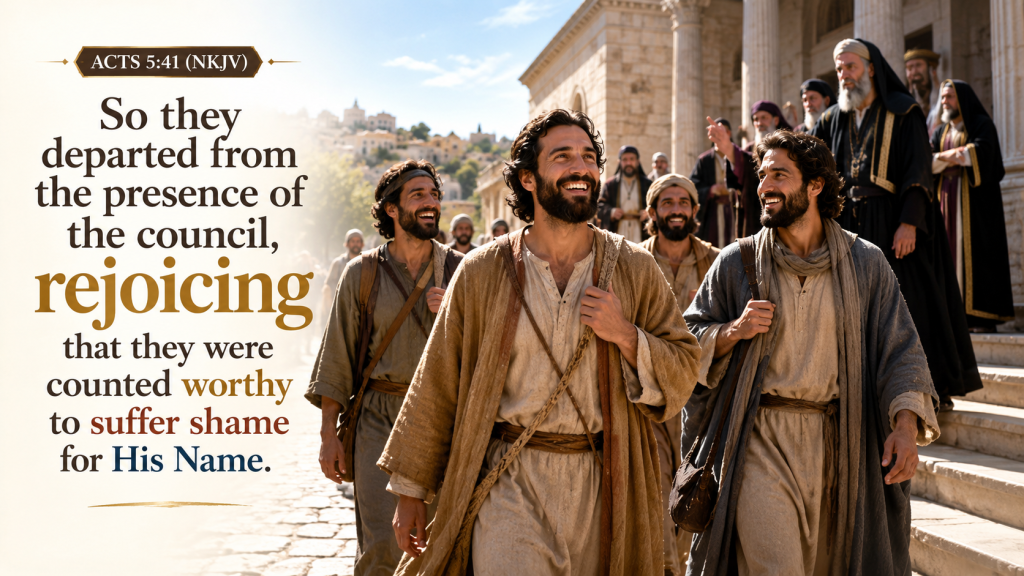
    I know this teaching is not popular but stay with me and endure this hard teaching. In Acts 5:41, the apostles rejoiced because God counted them worthy to suffer shame for His Name. We have been called to glory but the qualification (the judgement of being counted worthy) comes after faithfully suffering. This is clearly written in Scriptures in Romans 8:17: “Now if we are children, then we are heirs—heirs of God and co-heirs with Christ, if indeed we share in his sufferings in order that we may also share in His Glory.” Christ qualifies us to be worthy as children but our participation in His suffering determines whether we become co-heirs with Him in order to share in His glory.


    “For this reason, since the day we heard about you, we have not stopped praying for you. We continually ask God to fill you with the knowledge of his Will through all the wisdom and understanding that the Spirit gives, [10] so that you may live a life worthy of the Lord and please him in every way: bearing fruit in every good work, growing in the knowledge of God“, Colossians 1:9-10 says.

    Ephesians 4:1-3 NKJV
    I, therefore, the prisoner of the Lord, beseech you to walk worthy of the calling with which you were called, with all lowliness and gentleness, with longsuffering, bearing with one another in love, endeavoring to keep the unity of the Spirit in the bond of peace.

    I Thessalonians 2:10-12 NKJV
    You are witnesses, and God also, how devoutly and justly and blamelessly we behaved ourselves among you who believe; as you know how we exhorted, and comforted, and charged every one of you, as a father does his own children, that you would walk worthy of God who calls you into His own kingdom and glory.

    Don’t get it twisted. You are called into the Kingdom alright but you ought to walk worthy of your calling, as Ephesians 4:1 says. The calling is by Mercy and Grace. God’s judgement of our worthiness is by His Righteousness and Justice. This is the Truth. Jesus made you accepted so you live a life that is acceptable. Without Jesus, you can never be worthy. However, if our lives do not reflect the life of God Christ gave us, then we did not walk worthy of the calling. There is a manner of life worthy of saints.

    Romans 16:1-2 NKJV
    I commend to you Phoebe our sister, who is a servant of the church in Cenchrea, that you may receive her in the Lord in a manner worthy of the saints, and assist her in whatever business she has need of you; for indeed she has been a helper of many and of myself also.

    Philippians 1:27 NKJV
    Only let your conduct be worthy of the gospel of Christ, so that whether I come and see you or am absent, I may hear of your affairs, that you stand fast in one spirit, with one mind striving together for the faith of the gospel

    III John 1:5-8 NKJV
    [5] Beloved, you do faithfully whatever you do for the brethren and for strangers, [6] who have borne witness of your love before the church. If you send them forward manner worthy of God, you will do well, [7] because they went forth for His name’s sake, taking nothing from the Gentiles. [8] We therefore ought to receive such, that we may become fellow workers for the truth.

    Suffering for Righteousness’ Sake

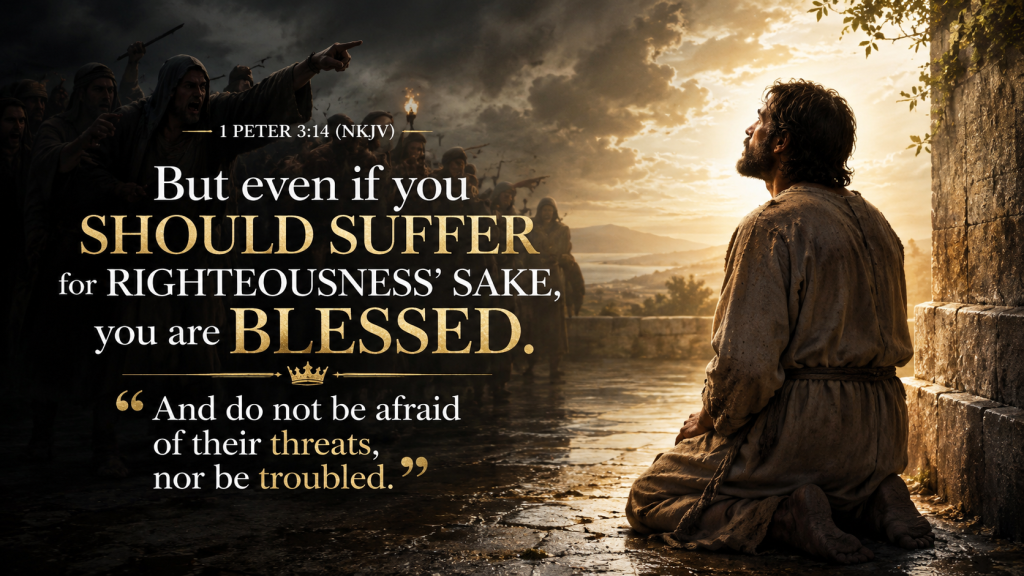
    There is blessing in suffering for Christ. Not all suffering is a blessing, of course. Not every suffering is a curse either. There’s a blessing in enduring temptation and overcoming them. Temptation is the platform for the internal contention between the flesh and the Spirit. Our bodies are in a fallen state and more susceptible to the things of this world. The civilization of this self-government is what is called flesh. God did not create our bodies to govern itself by its dictates and appetites.

    That notwithstanding, God’s way called Righteousness is inherent in our born-again spirit. Therefore, we will continually suffer the contention between our flesh (our bodies wanting to govern itself) and the Spirit (who is one with our spirit). Whenever we win this battle by walking in the Spirit, we are approved and counted worthy to receive a certain reward.

    James 1:12 NKJV
    Blessed is the man who endures temptation; for when he has been approved, he will receive the crown of life which the Lord has promised to those who love Him.

    Apart from the internal suffering, there’s external suffering for Righteousness’ sake. “Others may, you cannot“. “We are allowed to do anything,” so they say. That is true, but not everything is good. “We are allowed to do anything”—but not everything is helpful. That is 1 Corinthians 10:23. There will certainly be external persecution and pressure to conform to the dictates of this world. God’s way won’t be popular. It will be seen as radical and judged as insane. However, when you have been approved – when you have been counted worthy and faithful – you will receive the crown of life.

    I Corinthians 1:27-29 NKJV
    [27] But God has chosen the foolish things of the world to put to shame the wise, and God has chosen the weak things of the world to put to shame the things which are mighty; [28] and the base things of the world and the things which are despised God has chosen, and the things which are not, to bring to nothing the things that are, [29] that no flesh should glory in His presence.

    Be ready and willing to choose the way of the Lord, and utterly rejoice for being counted worthy to suffer for the sake of righteousness. It is a blessing. Matthew 5:11-12 says “Blessed are you when they revile and persecute you, and say all kinds of evil against you falsely for My sake. Rejoice and be exceedingly glad, for great is your reward in heaven, for so they persecuted the prophets who were before you.”

    The Fellowship of His Sufferings

    Jesus suffered too. Jesus is our Template and there are certain things He did that we must by all means do. One of them is suffering for Righteousness’ sake. Can we fulfill all our destiny without having to suffer? Well, that’s what Jesus’ suffering in the garden of Gethsemane was all about. God the Father confirmed that His Will includes the suffering and that there’s no other way around it. We are called partake of this same suffering, so that we can partake in the Glory. No Cross, no Throne.

    “Therefore, since Christ suffered for us in the flesh, arm yourselves also with the same mind, for he who has suffered in the flesh has ceased from sin, that he no longer should live the rest of his time in the flesh for the lusts of men, but for the will of God.” 1 Peter 4:1-2 said it beautifully. One of the reasons why Jesus lived a sinless life is because He suffered in the flesh. If we are willing to suffer in the flesh, we shall cease from sin. The squirming of the flesh whenever you say no to its lustful pleasures is suffering. But that’s not the only kind of suffering.

    Hebrews 12:3-4 says “consider Him who endured such hostility from sinners against Himself, lest you become weary and discouraged in your souls. You have not yet resisted to bloodshed, striving against sin.” Jesus suffered unto death, and so has many saints of old. The suffering as a result of the contention between the flesh and the Spirit cannot be compared to choosing God over your own life. If He died for us, we ought to be willing to live for Him. If He lives for us, we ought to be willing to die for Him.

    There’s a mindset and heart posture we ought to have in order to partake in the fellowship of His sufferings. 1 Peter 4:1 tells us about the mindset and 1 Peter 3:16 tells us about the heart posture. The heart posture is to reverse Christ in our hearts. That means fear God in your heart. The heart posture is also to keep the hope of Glory in your heart with meekness and fear. The fear of God will keep you from sin and keep your hope alive. It will also keep you from the pressure of evil men and all appearances of evil. That is what kept Joseph from committing such great wickedness against God and his master.

    There’s Grace for His Disgrace

    You may suffer slander, defamation, false accusations, character assassinations etc just like Daniel. However, your life of holiness and integrity will keep your conscience clean. What I mean by that is: when you begin to suffer, you’ll not feel guilty and attribute it to God’s judgement on your wrongdoings. You’ll rather rejoice that God has counted you worthy to suffer so that you’ll be worthy to be promoted from glory to glory. There’s some sufferings that is God’s Will. You may not understand. You may not agree. Regardless, that is God’s righteous judgement in this age; that His saints suffer for Righteousness’ sake, just as Christ did. This is called the perseverance of the saints, the fellowship of His sufferings.


    “It is better, if it is the will of God, to suffer for doing good than for doing evil”, 1 Peter 3:17 says. The Will of God includes suffering for doing good. It doesn’t always mean or include suffering but it always means doing what is good in God’s sight. Therefore, if doing this good will cause you to suffer, that suffering cannot be separated from God’s Will. God’s Will includes that suffering. It is important that teachings like these are re-emphasized so that those who suffer for doing good do not lose their hope. It has become more easier than ever to choose the compromised sinful way out and call it a testimony. We ought to know for sure that suffering is part of the journey.

    Jesus suffered in God’s Will. I Peter 3:18 says ” for Christ also suffered once for sins, the just for the unjust, that He might bring us to God, being put to death in the flesh but made alive by the Spirit”. Christ’s suffering resulted in 3 major things mentioned here;

    just for the unjust → divine exchange / substitution

    bring us to God → reconciliation

    put to death in flesh, made alive by the Spirit → death & resurrection

    Thus, you clearly see that Christ could not have completed His mission if He didn’t suffer. The same goes for you. This is the heart posture and mindset I want you to have. If you don’t partake in Christ’s sufferings, your fellowship is incomplete. That means you don’t know Him. It is in suffering that we are conformed to His death, that we may attain resurrection. If we don’t mortify the flesh, we cannot be made alive in the Spirit. If this suffering means dying for the sake of the Gospel, then so be it. Now, are you ready to suffer for His Name sake?

  • Understanding the Judgement of God

    Understanding the Judgement of God

    Picture yourself in a large white room of sparkling crystals. Everyone and everything is white. All of a sudden, a person who fell into a muddy, smelly gutter runs into the room. Huge chunks of dirt is left in his tracks and oily mud drips from his clothes unto the floor. How do you feel? You will immediately run to halt the person in his tracks so he doesn’t continue to ruin the beauty of the space. You might as well sack the person, wouldn’t you? That is how it is with holiness and sin.

    The Holiness of God

    Before we can understand God’s brutal judgement against sin, we ought to understand the Holiness of God. To be holy is to be set apart, consecrated and be unique. God is in His own class called the God class. Imagine you were all-Powerful, all-Knowing, All-Sufficient, Immortal and Omnipresent; how will you feel if someone dared to disobey you? How do you feel when your subordinate, your junior associate, your little child, anyone far below you disobeys you? We have no idea who we are dealing with when we sin. That is why God is to be feared. The angels cry “Holy, Holy, Holy”, because we cannot fathom the breadth and depth of this Being.

    The Holiness of God burns against sin. It is to it like a launderer’s soap or a refiner’s fire. This burning is what is known as the Wrath of God. No, the wrath of God is not some angry judgemental being who can’t seem to let things go. This is a holy, righteous anger against sin. The judgement of God purges! Whenever a substance is corrupted beyond recovery, it is subjected to mortality and left as an insignia to all who choose to stand against the LORD. You cannot rebel against God and win.

    Does that mean God is willing to destroy, just to keep His “holy ego”? First of all, God cannot be proud. To be proud is to see yourself bigger than you are. God cannot be any bigger than He is. He is bigger than big. He is who He is! Thus, God is not exaggerating His fury against sin. Thinking sin is not a big deal is sin in itself. It is a really big deal, especially since it is against an eternal holy God. Going back to our story, imagine there’s an owner of that all-white space and He had written a notice that no dirt is allowed in. You get it now!

    The Mercy of God

    It is amazing how this Fearful One is also the Merciful One. Even Lucifer was not outrightly judged the very day iniquity was found in him. He was given time to repent as the time for his judgement was set. In fact, all angelic beings were given the choice to either stand with God or rebel with satan. When satan was reduced to mortality, God in His infinite love allowed that same offer to be extended to men; “do you choose God or you choose to be your own god?”.

    The devil did not have a devil. He fathered his own rebellion. In the case of man, we believed the devil and rebelled against God. The question many will now ask is, “why would God allow the devil to tempt man?’. Unlike us, God is fully secure in Himself. He will always give one the chance to choose due to His Love. Love gives us the opportunity to choose, even if the other option is to rebel. Do you understand what I mean? We will be given the decision to choose God everyday, not just in this life but in all ages to come. Once you create the choice for obedience, disobedience becomes an option too. We choose obedience, not because disobedience is not a possibility but because we love Him.


    If you want to understand God’s fierce judgement against sin, look at all Jesus had to go through as your substitute. That tells it all

    To be continued…

  • Speaking the Truth in Love

    Speaking the Truth in Love

    But speaking the truth in love may grow up into him in all things, which is the head, even Christ:
    Ephesians 4:15 KJV

    The only thing deeper than truth is love. Love and truth are the most misunderstood, most controversial, most misinterpreted yet the most needful. There can be differences between anything and everything because of truth. In the same vein, there can be similarities between anything and everything because of love. Both are the web that ties and chains all things as unending and complex as the universe itself. Both are the most unknown, yet the most searched for.

    There is a difference between speaking the truth in love and loving to speak the truth. People normally offend others with their words and justify themselves by saying, “but that’s the truth”. The truth is never meant to hurt but heal. Disappointment hurts but Hope restores. That’s the Truth. There is difference between the Truth, and the emotions in which the truth is expressed. Hear me well! So if something is true and you say it in a rude way, you have communicated the truth in death. Don’t use the truth to hurt. Stop expressing the Truth in envy, bitterness, anger, jealousy etc. The only right way to communicate truth is in love.

    Speaking the truth in love is not the extreme too, where the truth is sugarcoated and made to lose its essence. That dilutes the truth into lies. You cannot love someone more than God. Godly sorrow leads to repentance. What we are saying is, communicate the truth with your mouth from a heart of love. There’s a place of pure genuine integrity where the truth expresses itself perfectly in Love. That place is Abba’s heart. In fact, that’s where all people are; in Abba’s heart.

    Love is the Ultimate truth. It is the beginning and the end. It is both the source and the focus of truth. Therefore, truth outside of love ceases to be truth. Just like everything else in the natural order, truth has boundaries, not limitations. The boundary of truth is love. Love is what protects the cell structure of truth. Love is truth. If there was no love, there wouldn’t be a need for truth.

    When someone who speaks the Truth in Love speaks, everyone always loves to listen. Not because there is a showoff of wisdom, but because there is this Love we can all connect to. That is what Abba Father created all things to be. Everything that has breath gives life. Life is not only given in sexual reproduction, but in other forms of production and reproduction, especially in our words.

    The Wise Man says;
    What you say can preserve life or destroy it; so you must accept the consequences of your words.
    Proverbs 18:21 GNB

    Whenever you hear something doctrinal and it puts you in fear and shame or it grips you like a force of bondage, then you didn’t hear the truth. The Truth ALWAYS liberates you. It sets you free from your own thinking; your own limits; your own restraint.

    When you hang around people who are broken, our compassion makes us feel and understand what they think, but that doesn’t mean that we should take up their mindset. Compassion becomes perversion when we reduce our convictions to embrace the crooked. Christianity is not a calling into isolation, where we isolate ourselves entirely from people due to their negativities; poor, broken, rude, hot-tempered, gay, bully, or naughty. Christianity is not compromise of convictions either.

    If no isolation at one extreme, then no compromise at other extreme either. People hang out with the poor and then develop a negative attitude against the rich. Pastors accept everyone for who they are, even homosexuals, and then develop a theology that supports homosexuality. How are you bringing light when you become darkness?

    Hanging out with people who don’t believe in godly values doesn’t mean we have to take up their conviction. It is wrong to avoid gays because you’re the help from God they need. But it is equally wrong when we try to defend their stance as though it is right. That is NOT compassion. That is compromise.

    You don’t have to change your convictions to love a homosexual. You’re not even helping the homosexual when you change your convictions. Jesus had great compassion for the lady who committed adultery and was about to be stoned. Jesus didn’t condemn her. Neither did He support her. Love is NOT Incompassionate compromise. Love is uncompromising Compassion.

    The Truth always operates in Love. Truth spoken outside Love breeds fear. Fear breeds slaves and self-righteous hubris. Truth spoken in Love breeds freedom and hope. Freedom breeds joy and peace.

    Love takes no pleasure in evil but rejoices over the truth. 1 Corinthians 13:6 ICB

    Just as I have spoken the Truth in Love to you, may your every word produce and preserve life all around you. I love you ♥

  • Truth: the Eternal Reality of Outcomes

    Because we live in a fallen world of uncertain outcomes, we tend to think truth is relative. It’s not surprising that modern philosophy have shifted toward a “my truth” delusion. “What works for me is my truth. What works for you is your truth”. If you look at life from a humanistic perspective, nothing is guaranteed; the guilty goes scot-free, innocent people are punished, bread is not guaranteed to the wise, good people live poor, proud people get what they want, humility gets you treated like a carpet, your behaviour doesn’t matter as long as you have money, wicked people live long and live well; it’s all time and chance.

    Being born into a rich family guarantees you to be rich much more than diligence does. People can work hard all their lives and end up with nothing. Nothing seem guaranteed. It can easily look more like luck and random selection. Until you look beyond this frailed world. Part of the mystery of lawlessness, which we discussed under Material Prosperity in a World of Moral Poverty is that there’s a distortion of reality in this fallen world, which has led to manipulation of outcomes. It is an error. That means you can have a poor wise man and a rich fool, although wisdom is the bedrock of riches.

    The Hebrew word for truth is emet, which means faithfulness, trustworthiness, verity, reliability, stability and firmness. Jesus would say “verily, verily I say unto you”. Paul would say “this is a faithful and trustworthy saying”. It’s a sure banker. It’s something you can rely on with your whole life and not be disappointed in its outcome. An outcome so sure, not because it’s automatic, but because the Judge of all the Earth sees to it that His Word never fails. It may look like it failed in time but it never fails eternally.

    Eternal Equations

    To live circumspectly and not according to sight, you ought to feed your soul with eternal truths. Truth is the established law of reality whose foundations are eternal. It’s like mathematical equations. Regardless of the times, cultures, seasons, language, dispensations or characters involved, the outcome remains unchanging. Truth is a constant regardless of the variables at play.

    1 x 1 is 1 universally. Within the physicalities, there seem to be no absolutes. Beyond the physicalities, truth is always absolute. The Word of God is Truth. This Word is forever settled/established in Heaven. Examples of truth, if you may ask; all statements Jesus made, especially where He said “verily, verily”. Verity is truth. The Bible is full of eternal truths which are unchanging. Example is James 4:6-7. Whether you’re male or female, tall or short, born today or 1000 years ago, Ahab or Nebuchadnezzar, rich or poor, the resistance of God will activate against you once you become proud.

    Nobody can ever resist the devil unless He is submitted to God. Have you seen how it works? Psalm 1:6 is a law. It doesn’t matter what you are; once you are ungodly, your way is preset to perish. These eternal equations are in every book and in every chapter of Scriptures. There are already predetermined outcomes for certain paths. Once you choose that path, you can never escape the designed outcome. That is the reality of truth. “You cannot serve both God and money.” Try to live your life to disprove it and you’ll end up as an example of the truth.

    The Reality of Truth

    When Jesus said we will know the Truth, which will set us free, it was the Greek word for “reality”. That is where our general understanding of truth comes from. Something authentic, genuine, real. Somehow we don’t seem to draw the correlation between revelation and reality. Reality is what truly exists. Revelation is God uncovering that reality. Truth is the establishment of what has already been revealed. That means the humanistic perspective is a reality on its own. Our present circumstance is a reality on its own. God’s Word is the reality of God. But whose report will you believe? What reality do you live by?

    “If you’re willing and obedient, you’ll eat the good of the land”. The earth is preset to yield its fruit to those who are willing and obedient. In this equation, it doesn’t matter if you’re anointed, gifted or appointed; if you’re not willing in your obedience, the earth won’t respond. If you’re willing but do not obey, it still won’t make a difference. The law is clear, and so is its outcome. It is eternally true. You don’t even have to believe it for it to be true. It is true, regardless of whether it is believed or not. It is forever established. Seeing is not believing; believing is seeing.


    “They that know their God shall be strong and do exploits”. The knowledge of God is the prerequisite to receiving the strength to carry out exploits. The Scriptures define its own terminologies. So if it says “be strong in the Lord and in the Power of His Might”, other passages will show you how to be strong. One way is by knowing God. Thus, the Word says “they that know their God shall be strong”. The more you intimately you know God, the stronger you become in the Spirit. You become firm. In truth lies stability.

    The systems of this world has its own systems. Those systems include reward systems. If you’re in the Kingdom of God, there is a way of operation called Righteousness, that you ought to seek. “The rulers of the heathen lord it over them…but it shall not be so among you”. Some people will use the world’s system and come to church to give God glory. If you sinned to receive that breakthrough, that breakthrough is not from God. You cannot seek the Kingdom without seeking His Righteousness also. Righteousness is the operating system of God’s Kingdom. Don’t try to benefit from both kingdoms by activating their reward systems. Selah

  • Unjust Mercy: How One Forsakes their own Mercy

    In how to obtain mercy, we found out that confession of sins qualifies one to receive mercy. In confessing, you acknowledge to the witness of the Holy Spirit that what you did was wrong. Christ then takes you out of sin and takes sin out of you. Sin makes one a candidate for judgement. However, God always shows mercy before executing judgement. God is just in showing mercy and merciful in executing justice.

    Commonly called unsanctified mercy, Unjust Mercy is expecting God to show mercy where it will be unjust. Showing mercy that goes against justice is ungodly. Imagining showing mercy to a rapist who clearly hasn’t repented of his ways; it is unjust to the many he will cause harm to. In Psalm 10:3, the Word says “the wicked blesses the greedy”. That is unjust Mercy. It’s the kind of mercy that doesn’t lead to repentance. It rather leads to more perpetuation of evil. Let’s start from the top!

    Merciful to All

    The calvanistic idea that some people are predestined to be the elect of God is such a religious idea. It is even against the power of choice God gave to man. Why would Jesus pay such a hefty price and then bar the “non-elect” who genuinely come to Him? That doesn’t make sense and is against many core verses in Scripture. Every religion thinks they are the elect and all others are false. Christianity is the only way that respects your choice, giving whosoever the opportunity to come into the Light. Most importantly, we don’t sentence anyone to death or even disown them if they want to leave the faith, something all other religions and cults never offer. We simply keep them in our prayers.

    There are sure mercies for everyone alive. If you have never been saved before and do not know the Gospel, it doesn’t matter how many years you served satan and committed evil. If you surrender to Jesus, He will accept you with open arms. This is mercy. Underserved but never unjust. The salvation in Christ rids you of eternal condemnation, a punishment far bigger than the natural consequences of your actions. This salvation is available to everyone. Whether you were the devil’s right hand man or his favourite girlfriend, it doesn’t matter. This is the Gospel – such Good News – the ministry of reconciliation given to all saints to tell the rest of the world.

    God showed mercy to Old Testament Jezebel and New Testament Jezebels. He showed mercy to Pharoah but Pharoah forsook his own Mercy. Who hasn’t God shown mercy to? God is just in showing mercy. You can obtain mercy; mercy can be multipled unto you, yes. That notwithstanding, God shows mercy to everyone because it is His nature, and the very idea of mercy is that it is shown to those who don’t deserve it. Everyone was given a time to repent. If they don’t, they forsook their own mercy, not that God didn’t show them mercy. He always does.

    Slow to Anger

    Exodus 34:6
    And the Lord passed before him and proclaimed, “The Lord, the Lord God, merciful and gracious, longsuffering, and abounding in goodness and truth,

    Numbers 14:18
    ‘The Lord is longsuffering and abundant in mercy, forgiving iniquity and transgression; but He by no means clears the guilty, visiting the iniquity of the fathers on the children to the third and fourth generation.’

    Nehemiah 9:17
    They refused to obey, and they were not mindful of Your wonders That You did among them. But they hardened their necks, And in their rebellion They appointed a leader To return to their bondage. But You are God, Ready to pardon, Gracious and merciful, Slow to anger, Abundant in kindness, And did not forsake them.

    Psalms 86:15
    But You, O Lord, are a God full of compassion, and gracious, Longsuffering and abundant in mercy and truth.


    Psalms 145:8-9
    The Lord is gracious and full of compassion, Slow to anger and great in mercy. The Lord is good to all, And His tender mercies are over all His works.

    Joel 2:13 NKJV
    So rend your heart, and not your garments; Return to the Lord your God, For He is gracious and merciful, Slow to anger, and of great kindness; And He relents from doing harm.

    Jonah 4:2 NKJV
    So he prayed to the Lord, and said, “Ah, Lord, was not this what I said when I was still in my country? Therefore I fled previously to Tarshish; for I know that You are a gracious and merciful God, slow to anger and abundant in lovingkindness, One who relents from doing harm.

    Nahum 1:3 NKJV
    The Lord is slow to anger and great in power, And will not at all acquit the wicked. The Lord has His way In the whirlwind and in the storm, And the clouds are the dust of His feet.

    So have you clearly seen that Grace did not start in the New Testament? God has always been gracious. We have this weird notion that God was always quick to judge in the Old Testament but it’s clearly not an accurate way of looking at it. That mindset can lead one to abuse grace because it makes us think judgement is no longer available in the New Testament. Judgement is not the opposite of Mercy; it is the complement of it. God has to be both merciful and just to forgive you. That’s what 1 John 1:9 says. God never pours out judgement without first showing Mercy. Before He pours out judgement, He warns severally.

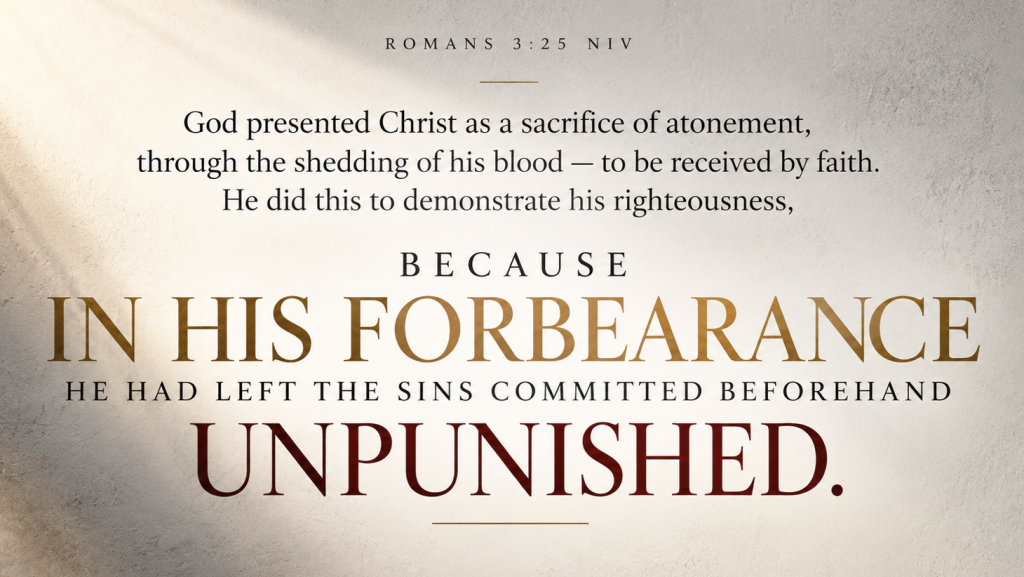
    This is the forbearance of God. Romans 3:25 says He even forbears with the many sins of unbelievers before they actually encounter the Gospel. He is long-suffering. He is slow to anger. He showed mercy to literally everyone. When we discuss Justice, we will talk about the wrath of the Lamb, the reciprocity of God and how a loving Father is also a Righteous Judge. We will talk a bit about the justice in the kingdom of darkness because after enjoying the pleasures of sin, sin would also want to benefit from you. So you’ll find a lot of people in sexual sins enjoying themselves at the beginning. When they finally want to stop, they realize they are stuck in the addiction they don’t enjoy anymore.

    How to Forsake Your Own Mercy

    If God shows mercy to all, and God is slow to anger, how come He condemns others still in judgement? They forsook God’s mercy. They rejected the warnings, scoffed at His messengers, lived double lives and obeyed their sinful lusts although God clearly showed them mercy. 2 Chronicles 36:16 says “they mocked the messengers of God, despised His words, and scoffed at His prophets, until the wrath of the Lord arose against His people, till there was no remedy.”

    Beware of doctrines of demons who lie to you that the door will always been open. God will never show unjust Mercy. You can’t enjoy sin and still make it to Heaven. You’re not the first person to “discover” the loophole that you can sin as often as you want and repent later. All who discovered it ended up in hell. You cannot intentionally abuse grace and get away with it. There’s a way that seems right to man but in the end, it leads to death. One day, you’ll fraternize with evil and not see the need to come back into the light. Sin has degenerative power and will corrode how you see yourself and how you see God.

    Indeed, there is no remedy and no sacrifice left if you wilfully reject Jesus. Don’t insult the spirit of grace. Hebrews 10:26-29 says “if we sin willfully after we have received the knowledge of the truth, there no longer remains a sacrifice for sins, but a certain fearful expectation of judgment, and fiery indignation which will devour the adversaries. Anyone who has rejected Moses’ law dies without mercy on the testimony of two or three witnesses. Of how much worse punishment, do you suppose, will he be thought worthy who has trampled the Son of God underfoot, counted the blood of the covenant by which he was sanctified a common thing, and insulted the Spirit of grace?”

    Pharoah was shown mercy. 9 different times, God through Moses warned Pharoah about the coming judgement. After every single judgement came, he would repent and ask Moses to pray for God to stop the judgement. The merciful God answered all those prayers. Immediately there was no judgement, he would harden his heart and disobey God’s instructions to let God’s people go. When his long rope of mercy was done, there was no room for repentance.

    This is the pattern throughout all Scriptures; God shows mercy before judgement. He forewarns by declaring judgement. But between the verdict and the execution of the judgement, He gives a final call to repentance. This is literally in every book of the Bible. The truth is that, nobody can tell how long God will forbear with a man. Just as God reserves the right to predetermine people’s destinies, He also reserves the right to decide how long He will wait for the prodigal son. Nonetheless, just like in the case of the 5 foolish virgins, a time really comes when the door is closed and there is no remedy.


    My advice? Fear God. It is a dangerous thing to fall into the hands of the Living God. Today, if you will hear His voice, do not harden your hearts as in the rebellion. Learn from the people who have gone before you, lest you follow the way of Balaam. Stay away from polluted fountains; you may be listening to men of God who have made themselves gods of men, already on the path to destruction. “If people escape the moral filth of this world through the knowledge of our Lord and savior Jesus Christ, then get tangled up in it again and are overcome by it, they are worse off than they were before. It would be better for them never to have known the way of righteousness than, having come to know it, to turn back from the holy commandment entrusted to them.”

  • Mercy: How to Obtain Mercy at the Throne of Grace

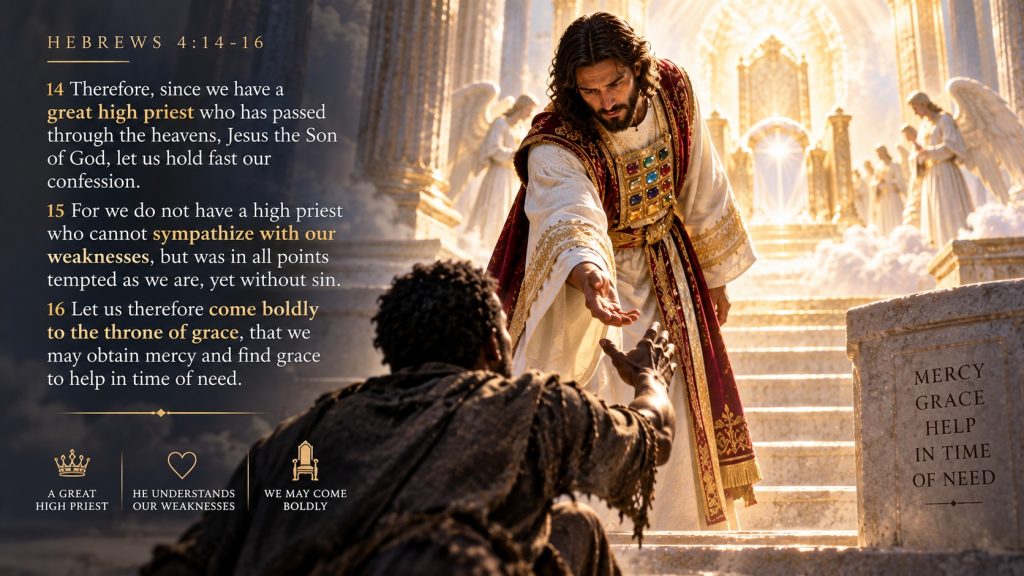
    God sits on the Mercy Seat on His Throne of Grace that is established on Truth, having Righteousness and Justice as the foundation of His Throne. Mercy is the overarching theme of the entire Scriptures, captured in the Hebrew word chesed. It means lovingkindness, covenanted love, mercy, grace, goodness, kindness, favour and faithfulness. Thus, when I say mercy, it is not devoid of love or grace. It is fundamentally the same essence. It’s important that we know this. It is the steadfast unfailing unconditional love of God that we are talking about.

    God’s Sovereign Love in Predestination

    God’s love is unconditional. That means He loves fully and freely regardless of the response of the object of His love. Everything God does is as a result of this Love, including things we may not understand like His wrath or discipline. God does everything He does out of love, for He is Love. By God’s lovingkindness, He created us and predestined us for His perfect Will without consulting us or adjusting it based on His foreknowledge of our mistakes and failures. This alone should put you at rest.

    There are certain things God chose for you without your input, knowing that it’s the very best of His Will for you; your family, your nation, your destiny, your gender etc. By the election of Grace, He chose you before time begun to fulfill a specific destiny at a specific time in history to bring glory to God. If you understand this, you won’t stress to do what God has not given you the grace to do. If you do all someone does intoto, you still won’t produce the results the person produces because the person’s effort is established on and facilitated by the grace allocated to them.

    It is not of him that wills or him that runs, but of God that shows mercy. Whatever comes naturally to you was allocated to you by grace. Yes, your gifts and talents; it’s from God’s abundant goodness and kindness. Predestination and election is by God’s sovereign love. The theme of your life, the boundary of your destiny, the texture of your calling, all by Mercy and Grace. When we talked about Main Character Syndrome, we said it’s not about being in the spotlight, but about following the light on your path. As great as Elijah and Elisha were, they were not predestined to be authors of any Scriptures. As honourable as Moses and Daniel were, they were not in the lineage of Jesus.

    Ephesians 3:8

    In God’s sovereign act of showing Mercy, it is usually in the area of the good works He predestined for you. Thus, certain orchestration you thought were random was engineered by God’s Mercy. It may not always be pleasant, but He uses it to glorify Himself. In I Timothy 1:1, Paul said “for this reason I obtained mercy, that in me first Jesus Christ might show all longsuffering, as a pattern to those who are going to believe on Him for everlasting life.” As a result, what the enemy meant for evil, God turns it around for good by His act of mercy. This is what it means to be a vessel of mercy.

    It is important to note, however, that predestination and election are only in the area of destiny, not in the determination of one’s eternity. Nobody has been predestined to go to hell. Everyone in hell was shown mercy before judgement. By God’s Grace and Mercy, He predestined all people to be saved. That means He decided to save us while we were yet sinners and undeserving of His Mercy. Thus, God can show mercy as His own sovereign act. That notwithstanding, He has also shown us mercy by making us worthy to approach Him, that we may obtain mercy. Let us dive in to that!

    How to Obtain Mercy

    So by God’s sovereign love, mercy was given you before you ever made a decision. This was what Romans 9 was about. That is only in areas where you had no decision to make, like where you will be born. However, there is mercy that is allocated to you based on your decisions. If not, we wouldn’t be told to come boldly to the Throne of Grace to obtain mercy. Mercy predestined me to write. However, if I ever feel like not writing, I can enter the Throne Room to access mercy. I hope you understand. The Bible usually uses the word “obtain” for mercy, so it’s necessary that we know how to obtain mercy. Mercy is not random selection. Mercy can be obtained.

    Asking for Mercy

    Don’t assume that God knows that you need mercy. Ask for mercy. Proof that you need it is that you asked. He is more than willing to show mercy. By asking, you give Him permission to lavish you with the multitude of His mercy. Ask for mercy everyday and never get tired of doing so.

    Psalms 86:3 NKJV
    Be merciful to me, O Lord, For I cry to You all day long.

    Psalms 123:3 CEB
    Have mercy on us, LORD! Have mercy because we’ve had more than enough shame.

    Matthew 20:30 NKJV
    And behold, two blind men sitting by the road, when they heard that Jesus was passing by, cried out, saying, “Have mercy on us, O Lord, Son of David!”

    Daniel 9:18 NKJV
    O my God, incline Your ear and hear; open Your eyes and see our desolations, and the city which is called by Your name; for we do not present our supplications before You because of our righteous deeds, but because of Your great mercies.

    Repentance

    Sins make you a candidate for judgement. However, once you repent and turn to the Lord, He is more than willing to forgive you, restore you and equip you to live above sin.

    Isaiah 55:6-7
    Seek the Lord while He may be found, Call upon Him while He is near. Let the wicked forsake his way, And the unrighteous man his thoughts; Let him return to the Lord, And He will have mercy on him; And to our God, For He will abundantly pardon.

    Proverbs 28:13
    He who covers his sins will not prosper, But whoever confesses and forsakes them will have mercy.

    Psalms 25:6-7 NKJV
    Remember, O Lord, Your tender mercies and Your lovingkindnesses, For they are from of old. Do not remember the sins of my youth, nor my transgressions; According to Your mercy remember me, For Your goodness’ sake, O Lord.

    Joel 2:13
    Let your broken heart show your sorrow; tearing your clothes is not enough.” Come back to the Lord your God. He is kind and full of mercy; he is patient and keeps his promise; he is always ready to forgive and not punish.

    Humility

    One thing God utterly and clearly hates is pride. Pride is the cardinal sin; every sin leads you to pride. It takes pride to live in sin. If there is one way to forsake God’s mercy, it’s by pride. The opposite is equally true.

    I Kings 21:29
    “See how Ahab has humbled himself before Me? Because he has humbled himself before Me, I will not bring the calamity in his days. In the days of his son I will bring the calamity on his house.”

    Proverbs 3:34 TPT
    If you walk with the mockers you will learn to mock, but God’s grace and favor flow to the meek.

    James 4:6
    But He gives more grace. Therefore He says: “God resists the proud, But gives grace to the humble.”

    Showing Mercy to be Shown Mercy

    Matthew 5:7
    Blessed are the merciful: for they shall obtain mercy.

    James 2:13
    There will be no mercy in judgment for anyone who hasn’t shown mercy. Mercy overrules judgment.

    Luke 6:36
    Be ye therefore merciful, as your Father also is merciful.

    Psalms 18:25
    With the merciful You will show Yourself merciful; With a blameless man You will show Yourself blameless;

    The Fear of God

    Psalm 103:11
    For as the heaven is high above the earth, so great is his mercy toward them that fear him.

    Psalm 103:17
    But the mercy of the LORD is from everlasting to everlasting upon them that fear him.

    Luke 1:50
    And his mercy is on them that fear him from generation to generation.

    Trusting God

    This is having an unshakable faith in the Word of God. He has never failed, and because He has made with you an everlasting covenant, His mercies are sure and trustworthy. Therefore, you can count on His mercy every time.

    Psalms 32:10
    Many sorrows shall be to the wicked; But he who trusts in the Lord, mercy shall surround him.

    Psalms 52:8 NKJV
    But I am like a green olive tree in the house of God; I trust in the mercy of God forever and ever.

    Psalms 13:5 NKJV
    But I have trusted in Your mercy; My heart shall rejoice in Your salvation.

    Loving & Obeying God

    Psalms 25:10
    All the paths of the Lord are mercy and truth, To such as keep His covenant and His testimonies.

    Exodus 20:6
    [I] show mercy to thousands, to those who love Me and keep My commandments.

    Daniel 9:4
    And I prayed to the Lord my God, and made confession, and said, “O Lord, great and awesome God, who keeps His covenant and mercy with those who love Him, and with those who keep His commandments

    Righteousness & Justice

    We see the interplay of the 4 again; whoever works righteousness, lives in truth, shows mercy and renders justice pleases the Lord. God being a Just Judge will be His exceeding Reward.

    Hosea 10:12
    Sow for yourselves righteousness; Reap in mercy; Break up your fallow ground, For it is time to seek the Lord, Till He comes and rains righteousness on you.

    Psalms 37:21
    The wicked borrows and does not repay, But the righteous shows mercy and gives.

    Proverbs 14:21
    He who despises his neighbor sins; But he who has mercy on the poor, happy is he.


    I hope this was very eye-opening. God shows mercy to those He loves, which is essentially everyone. He also shows mercy to those who love Him. Next week, we will talk about how to forsake your own mercy.

  • Mercy and Truth, Righteousness and Justice!

    In my studies of the book of Psalms, I discovered a collocation. I saw mercy and truth together. Whenever I saw righteousness in certain contexts, I simply knew justice was lurking somewhere behind. I’ve studied Scriptures meticulously enough to know that nothing in the Bible is ever by accident or coincidence. Even the details we think are redundant are tremendously intentional. These collocations were no different. Today being the introduction, I’ll simply give a general overview and show you all where these four occur in Scriptures. The next four parts will go into detail for each one.

    In the courtroom of Heaven, God sits as the Judge. Satan, meaning accuser, has a role in the courts as well. In fact, Satan’s role as the accuser of the brethren in the courts of Heaven is more well known to the average believer than our role. If you don’t know your role and authority in these courts, a lot of things in life will not only confuse you; it will make you a victim. Thus, this 5-part series is given for you to understand these 4 pillars that operate in the courtroom of Heaven; Mercy, Truth, Righteousness and Justice.

    Every single decision, intent and outcome passes through this courtroom. Whether in eternity or in time, every decision is foreknown by the Omniscient God, and He chooses to allow or approve based on the 4 collocations. That means nothing has ever happened that wasn’t first approved, acknowledged or allowed by God. If God does not allow or permit something to happen, it can never happen. This Truth can make a lot of us confused, especially when we focus on all the evil and atrocious activities that do happen. However, the fact that God allows it does not mean He condones it.

    God is Just, therefore, He cannot disobey His own Word. He will never disobey one Truth to obey another. He justifies every single action He takes, although He does not need to justify Himself to anybody. Every single decision He makes is merciful, true, righteous and just. All parametres must be fulfilled. That’s how God works. Every single thing that God has ever done and will ever do is within these 4 pillars, all at the same time. Jesus dying on the Cross is the pinnacle of this revelation. On the Cross, we saw Mercy, Truth, Righteousness and Justice all fulfilled.

    I don’t want to be God. Only God can be God. Because this is so incomprehensible, especially to the human mind. Do you understand? If God wants to show you mercy, He has to be true, right and just. If God wants to judge, it ought to be merciful, true and righteous. At no point has any been left out. If God is to choose Jacob and not Esau, He needs to justify His decision. If God favours you instead of anyone else, it’s not random selection. Predestination and election is approved in the courts of Heaven. Many of the unfoldings of this life were approved before the foundations of the world.

    God designed and approved every single person’s destiny before the foundations of the world. Do you get it? He designed everything before He started. That notwithstanding, predestination and foreknowledge are two different things. There are also things God did not predestine but allowed although He foreknew. Even what He allows is based on Mercy, Truth, Righteousness and Justice. It’s not all things that you need to understand before you believe. This should be one of them. If you check really well, there’s a balance to it too. Mercy balances Truth. Righteousness balances Justice. What is Truth without Love? What is Grace without Truth?  Think about it! What is Justice without Righteousness? What is Justice without Truth and what is Mercy without Justice?

    There are many things that God allowed, although He never predestined, because legality was secured by the kingdom of darkness. That’s why you need to understand the jurisdiction of the devil. Because God is just and the person involved broke God’s Word, satan can secure rights in the court of Heaven to perpetuate evil legally. How? An example is when Adam fell. Adam not only disobeyed God; he directly obeyed the devil. The Truth of God’s Word says we are slaves to whomever we obey. Because of this truth, justice demands that we become slaves to death – the one we obeyed.

    However, because of God’s mercy, Adam was not directly cursed. He cursed the ground for Adam’s sake and did not allow humanity to reap the full repurcussion of our gross disobedience. Instead, He paved a way of escape from death according to His Righteousness. He foreknew that Adam would sin but still went on to create man because He had predestined that although man would fall, He would save man according to His Righteousness.

    What I mean by “according to His Righteousness” is that God cannot now speak words for our death penalty to be paid although He is All-Powerful. That would violate His own Word when He said “ye shall surely die”. So someone still needs to die for justice to be fully served. The person needs to be a man for it to be right and just. Thus, God became man, lived a perfect life so He can exchange His life for our death and suffer the full repurcussions of our sins, satisfying Mercy, Truth, Righteousness and Justice. The wrath of God against sin needed to be satisfied; that wrath was poured upon Christ.

    This is going to be an exciting series, isn’t it? Mercy, Truth, Righteousness, Justice!

  • Material Prosperity in the World of Moral Poverty

    It’s not rocket science to ascertain the moral poverty in our society and in the entirety of human history. Whenever we made progress as a people in a civilization, it increased the possibility of ruining it all in a grandeuse manner. We take one step forward and three steps backwards. Even a simple blessing like a natural resource can become a huge curse to the people it belongs to. Something is fundamentally wrong everywhere in every field, in every nation and in every discourse. We can’t pretend it’s not there. We can’t beat around the bush. It’s the reality of evil.

    Fallen State

    The fact that people find it hard to believe in God, the epitome of good, and literally nobody doubts the existence of evil should tell you something. This world is fallen. The natural man is in a fallen state. Thus, no matter how far the world progresses, it will only be employed to propagate more manifestations of evil that never existed hitherto. Every single tool man has ever invented – from cars to the Internet to AI – always started as a good solution to existing problems, only to end in a dilemma of evil fashions.

    Since we live in a fallen world, the law of diminishing returns rules over the realm. Everything leans towards the negative side. In this realm, barely are there any absolutes, and everything can have a positive and negative repercussion for it. Thus, those who do evil can benefit from it; a reality inconsistent with the original design and system God created to govern the world. All such inconsistencies are discussed in the book of Ecclesiastes, where the author calls them meaningless. Do we have values anymore? Are they still emphasized?

    If the only reason we teach people to avoid evil is because of natural consequences, they’ll grow to enter the systemic evil and realize how elites spend resources to alleviate consequences. Evil is not evil because an evildoer will reap evil consequences. It’s possible to benefit from evil and deflect all its natural consequences. Because of the benefits and no imminent “karmic retributions”, posterity will rise to embrace such evil as good. Because the sentence against an evil work is not executed speedily, therefore the heart of the sons of men is fully set in them to do evil (Ecclesiastes 8:11).

    The Mystery of Evil

    What do you mean the race is not for the swift? Bread is not to the wise? You’re telling me you can be a fool and still be rich? So it’s possible to be a poor wise man? How can evil prosper? Why do good people suffer? It does not obey the laws and principles and order. No wonder the Bible calls lawlessness a mystery. No matter how much the world prospers materially, all such material wealth will be used to expand the boundaries of evil creatively. The problem has never been without but within. Technology can be designed to make the world safer until someone redesigns the same technology as the very threat. Tools are neutral. Tools in the hands of evil become evil tools.

    You may think I’m just philosophizing. How do you make sense of the Epstein case? Do you know that up until now, not a single person has been prosecuted in connection to it? The world gets better materially, but keeps rotting morally. Right now, the masses are being conditioned to seeing evil go unprosecuted. Expecting justice from a system of injustice never made sense anyway. That notwithstanding, anytime you saw the system judge evil, it only got rid of what Haman created. It never got rid of what created Haman in the first place. That’s the real definition of systemic.

    Don’t let the city lights fool you. There’s so much evil in this world. That is not to make you fear or put you in a panic mode where you anticipate evil overcoming you as though you’re a victim. This is to make you aware that there’s a spirit more ancient than material in this world, the spirit of this age. It indoctrinates that good can co-exist with evil. Some of the nicest people in the room of global influence and within the corridors of power are satanists who eat babies for breakfast. Your brain will not be able to fuse those two characters into one person. Slavery hasn’t ended. It has evolved. Human trafficking is the highest now than it has ever been. The world rots from within.

    the Systems of this World

    The systems of this world is fashioned to beat you into conformity. It can pull all the strings on you in an attempt to beat into line. Just look at the rat race. Despair is one of the silent evils of this world. Once you bring a person into that state, you blur their lens of good and evil. It now becomes by hook or crook for them. Before they realize, they are benefitting from the evil they used to condemn. Another is poverty. The vicissitudes of life captures it all, and it is fashioned to make you crumble, focus on your survival, and never walk the path of destiny. It is all an attempt to keep you from seeking God’s Will for your life.

    The systems of this world has 3 main expressions: the lust of the flesh, the lust of the eyes, and the pride of life. The lust of the flesh because your flesh is your weakest link. It’s still in its fallen state, and therefore more susceptible to evil than any other part of you. The lust of the eyes, because your eyes is the biggest gate into your person. Scientifically, it accounts for over 80% of the information your brain receives. It is more powerful than all your senses combined. The pride of life is how you incarnate the spirit of the antichrist into your vessel. It’s the cardinal sin.

    Being the Light of the World

    If you want to be the light, you first have to come out of the darkness. In Christ, we are transported from the kingdom of darkness into His marvelous Light. The kingdom of darkness has their own “light”. Remember, the epitome of evil used to sit in the office of a lightbearer. His light is now darkness. If you have anything to do with this darkness, you’ll never overcome it. By dwelling in the Light only, you escape the corruption that is in this world through lusts.

    There’s a way you can be rich, not by the means of mammon. Yes, you can be tremendously influential even in evil Babylon as a Daniel and not be stained by darkness. It’s never by having a victim mentality as though darkness can cover light. Light rather shines in darkness. Even in the deepest darkness, light shines the brightest. However, take an absolute stance never to defile yourself. You can never overcome evil with evil. We rather overcome evil with good.